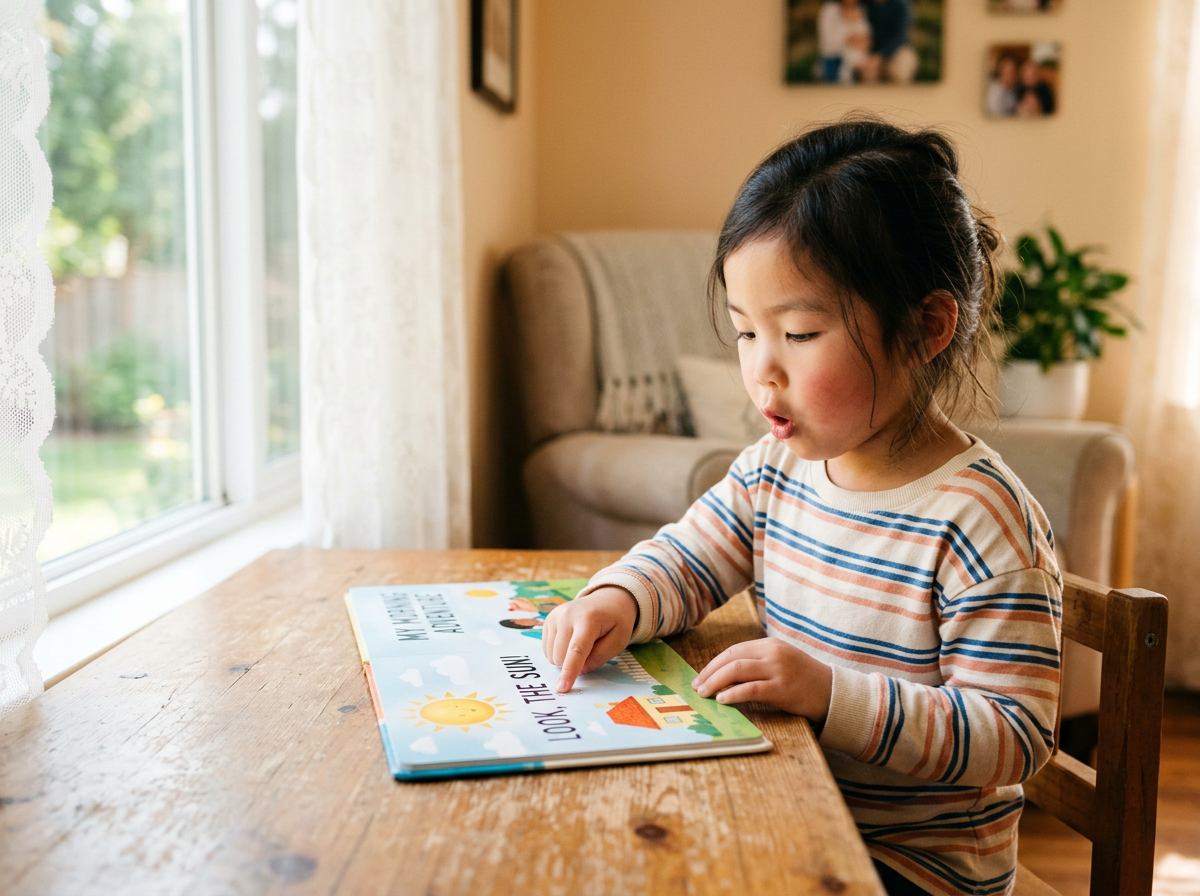
Most parents assume that if you surround a child with books and read to them often, reading will eventually click. It’s a reasonable assumption — we don’t formally teach our toddlers how to speak, and yet they do. Reading must work the same way, right?
It doesn’t.
Speaking is biologically natural. Every healthy child, in every culture, learns to talk simply by being immersed in language. Reading is not. It’s a recent invention — about 5,000 years old — and the human brain has no dedicated wiring for it. Each generation has to be taught how to read, deliberately, almost entirely from scratch.
The good news: we now know, with more clarity than at any point in history, what works. The body of evidence is called the Science of Reading, and the most important insight inside it is this — children learn to read by being taught the connection between sounds and letters, in a careful, explicit sequence.
The two halves of reading
The classic model, called the Simple View of Reading, describes reading as the product of two skills:
- Decoding — the ability to look at a printed word and pronounce it.
- Language comprehension — the ability to understand what spoken language means.
Both have to be in place. A child who can decode words but doesn’t understand spoken English can read aloud without comprehending. A child who understands a story when it’s read to them, but can’t decode the words on the page, can’t read independently.
Most parents focus heavily on the second half — building vocabulary, reading aloud, asking comprehension questions. That’s good. But the first half — decoding — is usually where families get stuck. And decoding has to be taught.
What “decoding” actually means
When a fluent reader looks at the word cat, it feels instantaneous. The word jumps off the page. But the brain isn’t recognizing cat as a whole picture. It’s running a lightning-fast process:
- See three letters: c, a, t.
- Map each letter to its sound: /k/, /a/, /t/.
- Blend the sounds together: cat.
This process is called phonics, and it’s the bridge between the alphabet — 26 letters — and the spoken language a child already knows. About 84% of English words are decodable through phonics if you know enough patterns. The rest are learned by a combination of pattern recognition and memorization.
For a beginning reader, every word is a small puzzle. With practice, the puzzle-solving becomes automatic — and at that point, the brain can devote its energy to meaning instead of pronunciation. That transition, from decoding to fluency, is the whole game.
What doesn’t work
For decades, schools tried two other approaches:
- Whole language — surround children with rich books and let reading emerge naturally. The theory was that reading was like speech: pick it up by immersion.
- Three-cueing (sometimes called “balanced literacy”) — teach kids to guess words from pictures and context, falling back on the first letter only if guessing fails.
Both have been studied carefully. Both leave a significant percentage of children behind — especially children without strong home literacy support. Guessing-based strategies look fine on early, predictable picture books. They fall apart in second and third grade, when the texts get harder and the pictures stop helping.
The phonics-first approach, by contrast, works for nearly every child. Including children with dyslexia, who need it more, not less.
Phonemic awareness comes first
Before a child can connect letters to sounds, they need to be able to hear individual sounds in words at all. This is called phonemic awareness, and it’s surprisingly hard for young children.
Try asking a four-year-old: “What’s the first sound in the word fish?” Most will say “fish.” They’re hearing the whole word as one piece. With practice, they learn to break it apart: /f/ … /i/ … /sh/. That skill — hearing the individual sounds — is the foundation everything else is built on.
Good phonemic awareness practice doesn’t involve letters at all. It’s done with the ears, often during car rides, bath time, or quiet moments before bed:
- “What word is /m/ /a/ /n/?” (man)
- “What’s the last sound in dog?” (/g/)
- “What’s cat without the /k/?” (at)
Three to five minutes a day of this kind of game, starting around age three or four, makes a profound difference.
What this means at home
You don’t need a teaching credential. You need a clear sequence and a few minutes a day. The right sequence looks something like:
- Sounds first. Play with the sounds inside words. Rhyming, beginning sounds, blending, segmenting.
- Then letters and their sounds. Start with a few high-frequency consonants and short vowels. Not in alphabetical order — alphabetical order is for the song, not for teaching reading.
- Then blending letters into words. Three-letter words first (cat, sun, big), then four (ship, frog).
- Then reading short, decodable sentences. Books that use only the patterns the child has been taught.
- Layer in tricky words slowly. Words like the, said, was that don’t follow standard rules get taught one by one.
This is the sequence used by every effective reading program in the world. It’s not a secret, and it’s not complicated. The hardest part is consistency — fifteen minutes a day, most days, for a year or two. That’s it.
What to do this week
If you’re starting from scratch, start here:
- Play one phonemic-awareness game today during a car ride or bath time. Pick three words and ask your child what the first sound is.
- Notice which letters your child already knows. Most kids learn the letters in their own name first.
- Read aloud, the way you already do — but slow down occasionally and point at a word. Just exposing your child to the connection between spoken sound and printed mark is valuable.
Reading is built one small skill at a time. None of those skills is hard on its own. The path is just longer and more deliberate than most parents are told.